Knobs vs. Pulls for Cabinets, Which one is right for you?
Cabinet hardware is the smallest decision in a kitchen or bath remodel, and it is also the one people touch the most. You open a door or pull a drawer dozens of times a day, so the piece you grab matters far more than its size suggests. The question comes up in nearly every design conversation: should the cabinets get knobs, pulls, or a mix of both? The honest answer depends on how you cook, who uses the room, and what look you want when the project is finished.
The Basic Difference Between Knobs and Pulls
A knob is a single, small piece that attaches to the cabinet with one screw. It is usually round, square, or oval, and you grip it between your fingers and thumb. A pull, sometimes called a handle, attaches at two points and gives you a bar or a shaped grip to wrap your hand around. Pulls come in many lengths, from a compact three inches to long runs that stretch across a wide drawer.
That small difference in shape changes how a cabinet feels in daily use, how it looks from across the room, and how much planning goes into placement.
How Each One Feels in Daily Use
Knobs are quick and light. They work well on doors you open with a gentle tug, and they are easy to reach for when your hands are full. The tradeoff is grip. A knob asks you to pinch, which can be less comfortable for someone with sore hands, or for a heavy drawer loaded with pots and pans.
Pulls give you more to hold. Four fingers can wrap around the grip, so a deep drawer slides open without much effort. If anyone in your home has arthritis, small hands, or limited strength, pulls are often the friendlier choice. Pulls also tend to be easier to use while wearing oven mitts or holding something in your other hand.
Where Knobs Work Best
Knobs shine on cabinet doors, especially upper cabinets and smaller base cabinet doors. They also suit narrow drawers, spice drawers, and bathroom vanity doors where a lighter touch is enough. In a traditional or transitional kitchen, a row of well-chosen knobs adds a quiet, classic detail without competing with the door style.
Knobs can also be a smart way to add character to a simple door. A plain Shaker door picks up a lot of personality from a knob with an interesting shape or finish.
Where Pulls Work Best
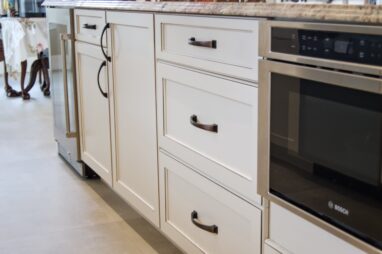
Pulls belong on wide drawers and large pot drawers, which carry real weight and need a secure grip. They also work well on tall pantry doors and appliance panels, where a longer handle gives you leverage. Many designers like pulls on lower cabinets because they line up with the natural reach of your hand.
Pulls also create strong visual lines. A run of matching bar pulls across a bank of drawers reads as clean and deliberate, which is why they show up so often in modern and contemporary spaces.
Matching Hardware to Your Style
Traditional and Transitional Kitchens
Classic kitchens often lean on knobs for doors and cup pulls or bin pulls for drawers. Soft curves, detailed profiles, and warm finishes such as antique brass or oil rubbed bronze fit comfortably with raised panel or inset doors.
Modern and Contemporary Kitchens
Sleek bar pulls in brushed nickel, matte black, or polished chrome suit flat panel doors and minimal lines. Oversized pulls make a bold statement, while slim ones nearly disappear into the cabinet.
Farmhouse and Coastal Looks
These styles are relaxed, so they welcome texture. Simple knobs, ring pulls, and softly finished metals blend with painted cabinets and natural wood tones. Whatever style you choose, the hardware should feel like it belongs to the whole room, not like an afterthought.
Size and Placement Rules That Prevent Regrets
Scale is where many homeowners go wrong. A pull that looks perfect in a catalog can look tiny on a thirty-six inch drawer, and a large knob can overwhelm a narrow door. A helpful starting point is to match the pull length to the drawer width, using one third of the drawer front, and to choose knobs that feel proportional to the door.
Placement matters just as much. Knobs on doors usually sit near the corner that is farthest from the hinge, on the lower corner of upper cabinets and the upper corner of base cabinets. Pulls on drawers are commonly centered, and long drawers sometimes get two. Keeping the same placement across the whole room is what makes the finished kitchen look polished.
Can You Mix Knobs and Pulls?
Yes, and it is one of the most popular approaches. A common pairing is knobs on all the doors and pulls on all the drawers, in the same finish and style family. The mix gives each cabinet the grip that suits it best while keeping the room consistent. The key is to keep the finish and the design language matched so the two pieces look related rather than random.
Finish Matters More Than You Think
Hardware is a bit like jewelry for the room. Brushed nickel, antique brass, pewter, oil rubbed bronze, matte black, and polished chrome each set a different mood. Think about your faucet, lighting fixtures, and appliance finishes too. You do not need everything to match exactly, but the metals should feel like they belong in the same conversation. Durable finishes also hold up better to the daily wear that kitchens deliver.
Try It Before You Buy It
Photos can only tell you so much. The weight, the edge, and the way a piece fits your hand are things you learn by holding it. At JA Kitchen & Bath, we carry cabinet hardware from Top Knobs and Atlas Homewares, and you can see the pieces in person at our Broomall showroom. Ask about manufacturer sample programs so you can test a few options on your own cabinets before you decide.
Our team works with homeowners across the Main Line, Delaware County, Bucks County, Montgomery County, Chester County, and the Philadelphia area. We can help you decide whether knobs, pulls, or a thoughtful mix will serve your space best. Contact us today to schedule a showroom visit and choose hardware you will enjoy every single day.